
Knives
Knives are the most commonly used kitchen tools. They are an important part of any chef’s tool kit. A kitchen tool is an implement that is used in the kitchen.
Accomplished chefs can perform countless valuable tasks with a sharp knife. To perform these tasks, however, chefs must be familiar with knife construction and type. They must also use proper cutting techniques and knife safety. Finally, chefs must know how to care for knives properly so that they will last.
Some people advise buying very expensive knives. I say, if you're trying to be a pro, use pro tools. If you are just trying to prepare meals any good quality knife set will do. I have a really nice Cuisinart knife set with a knife block sitting on my prep table . . . and I still constantly go back to me high-carbon steel, 40 year old kitchen knives.
You also don't need "eleventy" knives. I probably use the same 4 or 5 knives day in and day out, only occasionally picking up a larger blade or slicer during a "special occasion".
Knife Construction
Knife Construction
To know which knife to use for a specific task, you must have a working knowledge of the different parts of a knife.
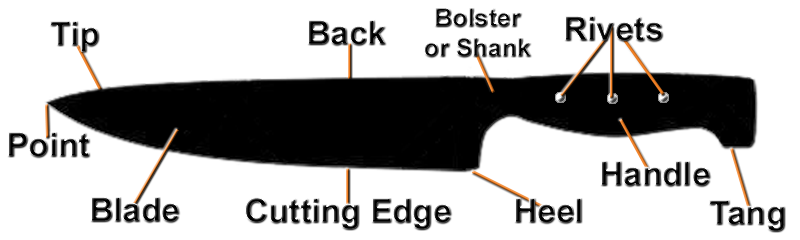
Blade
Blade
The blade of a high-quality knife is made of a cut, stamped, or forged single piece of metal. The metals most often used for knife blades are stainless steel and high-carbon stainless steel.
Stainless steel is a hard, durable metal made of chromium and carbon steel that does not rust or discolor. Stainless steel does not transfer a metallic taste to foods. The major drawback is that it is hard to sharpen and the edge is somewhat "brittle".
High-carbon stainless steel is an expensive mix of iron, carbon, chromium, and other metals that combine the best features of stainless steel and carbon steel, but it is expensive. It does not rust or discolor and can be sharpened easily. This is the most common metal used for hi-quality kitchen knives.
Many older home kitchen knives are made of high-carbon steel. This steel does rust and discolor, and requires more care, but many people consider vintage high-carbon steel knives to be superior to most modern made knives.
Tang
Tang
The tang is the part of the blade that continues into the knife’s handle. A full tang is as long as the whole knife handle.
Some knives (usually the better quality knives) have full tang blades, while others (cheaper quality)have partial tangs.
Knives used for heavy work, like chef’s knives and cleavers, should have full tang blades.
Knives used for lighter work, such as paring knives and utility knives, may have partial tang blades, but full tang is always preferred.
Handle
Handle
Knife handles can be made of several types of material, including plastic, vinyl, and hard woods like rosewood and walnut.
Because you hold the knife for long periods of time and work closely with it, the handle should feel comfortable in your hand. Your hand can cramp from using a handle that is too small or too large.
Try different sizes to find one that fits. Just because someone tells you "X" knife is the best, doesn't mean it's the best for you.
Rivet
Rivet
The tang is attached to the knife handle with rivets. Cutlers rivets, specifically, that are metal fasteners.
For comfort and sanitation, the rivets should be smooth and lie flush with the handle’s surface. Nothing should catch food and fluids to hold and allow bacterial growth.
Bolster
Bolster
Some knives have a shank, or bolster, at the place where the blade and handle come together.
Knives with a bolster are very strong and durable because the bolster helps prevent food particles from entering the space between the tang and the handle.
Types of Knives
Types of Knives
A cook chooses knives according to the type of food that they are preparing. For example, chopping onions requires a different knife than slicing bread.
Here's a rundown of some common types of knives.
Chef's Knife
Chef’s Knife
 The chef’s knife, also called a French knife, is the most important knife in the chef’s tool kit. In your kitchen, probably not. In the home kitchen, the utility knife is probably more important.
This all-purpose Chef's knife has an 8 to 14 inch triangular blade used for peeling, trimming, chopping, slicing, and dicing. The 10 inch chef’s knife is the size generally used.
A skilled chef can also use this knife to cut large foods, such as meat, poultry, and fish, into smaller pieces. You're not a skilled chef, so it may be more knife than you need.
A smaller knife, but similar in shape to a chef’s knife, is the utility knife. A utility knife is an all-purpose knife with a 5 to 7 inch blade. It is used mainly for peeling and slicing fruits and vegetables.
Slicer
Slicer

The slicer has a long, thin blade that is ideal for cutting large foods such as meat and poultry.
The tip of this knife may be pointed or rounded, depending on the manufacturer and the blade may be rigid or flexible.
Some slicer’s blades may also be serrated which can be used to slice coarse foods without crushing or tearing them.
Bread knives would be good examples of serrated slicers.
Boning Knife
Boning Knife

A small knife with a thin, angled 5 to 7 inch blade, the boning knife is used to remove bones from meat, fish, and poultry and trim fat from meat.
The blade may be rigid or flexible. Rigid blades are used for heavier work while flexible blades are used for lighter work.
Paring Knife
Paring Knife

The paring knife has a rigid blade that is only 2 to 4 inches long.
You can use this knife to pare, or "trim off", a thin outer layer or peel from fruits and vegetables.
Tournée Knife
Tournée Knife
 Similar in size to the paring knife, the tournée knife has a curved blade that looks like a bird’s beak.
It is used to trim potatoes and vegetables into shapes that look like footballs.
Fillet Knife
Fillet Knife

The fillet knife has an 8 to 9 inch blade with a pointed tip.
The blade may be rigid or flexible and is mainly used to fillet fish.
Butcher Knife
Butcher Knife
The butcher knife has a 6 to 14 inch rigid blade whose tip curves up at a 25-degree angle. It is sometimes called a scimitar because its curved blade resembles a saber by that name.
You can use the butcher knife to cut meat, poultry, and fish.
Cleaver
Cleaver
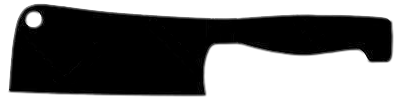
The cleaver iss a heavy chopping tool that is useful is butchering large cuts of meat or splitting an entire chicken into pieces.
This tool is not absolutely necessary, but like many specialized tools, when you need one, nothing else will do.
Shears
Shears 
Like the cleaver, kitchen shears are not absolutely essential, but they can make certain tasks much easier. If you cook a lot, and prepare most meals from scratch, a knife set with a good pair of kitchen shears is worth it.
Knife Skills
Knife Skills
To prepare basic meals, one of the most important skills you can learn is how to use a knife properly.
You can learn to use a knife to perform many different tasks, like boning fish, paring fruits, slicing bread, and dicing or mincing vegetables. You can learn to grip a knife in different ways to account for comfort and the task at hand.
As a general rule:
- A sharp knife is the safest knife to use
- Grip a knife firmly but not so tightly that your hand gets tired
- Avoid placing your index finger on the top of the blade
To make safe, even cuts, you guide the knife with one hand while holding the food firmly in place with the other. Curl the fingertips on the hand that holds the food to help avoid accidental cuts and use the sharp edge of the blade to do the cutting. Use smooth, even strokes, and never force the blade through the food. Let the knife do the cutting, not your force.
Like any skill, the more you practice, the more efficient you will become.
Knife Cuts
It is important to cut foods into uniform pieces that are even in shape and size so that they cook evenly, and using a properly sharpened knife avoids bruising foods such as onions and tomatoes.
The basic cutting techniques include slicing, mincing, and dicing. You can also roughly chop foods when visual appeal is not important, such as for stock vegtables. A rough chopped item, often vegetables, is called concassé.
Slicing
Slicing
When you slice food, you cut it into large, thin pieces.
To slice safely, make sure the flat side of the food is down so that it will not slip. If necessary, cut a piece of the food to create a flat surface.
You can make many different specialty slices
Chiffonade
Chiffonade
To chiffonade means to finely slice or shred leafy vegetables or herbs. This cut is often used to make garnishes.
Rondelle
Rondelle
A rondelle, or round, is a disk-shaped slice. Rondelles are made from cylindrical fruits or vegetables, such as cucumbers or carrots.
Diagonal
Diagonal
A diagonal cut results in an oval or elongated slice of a cylindrical fruit or vegetable.
The technique used to slice a diagonal is similar to the one used for a rondelle except you hold the knife at an angle to get an oval-shaped slice.
Roll Cut
Roll Cut
A roll cut, or oblique cut, is done by first cutting a cylindrical fruit or vegetable like a diagonal cut, rolling the fruit or vegetable 180 degrees, and then doing another diagonal cut.
This exposes more of the surface of the vegetable to decrease cooking time.
Mincing
Mincing
Food that is cut into very small pieces is minced. This technique is used most often on items such as shallots and garlic.
To dice a food, use a knife to cut julienne and batonnet sticks into 1∕8 to 5∕8-inch cubes.
Julienne
Julienne
Julienne cuts are 1∕8-inch thick matchstick-shaped cuts. Carrots are often cut julienne.
Batonnet
Batonnet
Batonnet cuts are ¼-inch thick matchstick-shaped cuts. Some restaurants serve batonnet-cut fried potatoes.
Brunoise
Brunoise
Brunoise cuts are 1∕8-inch thick cubes often cut from julienne cuts.
Knife Safety and Care
Knife Safety and Care
Now that you know a little about knives, how to select the right one and use it safely, you should know how to properly care for them.
- Sanitize your knives after every use and always store them properly.
- Keep your knives sharp and clean to keep them in the best condition.
- Use a sharpening stone to keep your knives sharp.
A good whetstone is a sharpening stone made of either silicon carbide or stone. It can have up to three sides, with grains ranging from coarse to fine.
After sharpening your knives, a steel should be used to keep the blade straight and to smooth out irregularities by trueing.
A steel should be used daily to keep your knives at their sharpest.
Use these knife safety guidelines:
- Always use the correct knife for the task.
- Always use a sharp knife. You will need to use more force with a dull knife.
- Always cut with the blade facing away from your body.
- Always use a cutting board.
- Never let the knife’s blade or handle hang over the edge of a cutting board or a table.
- Carry a knife by the handle with the point of the blade straight down at your side.
- The sharp edge should face behind you.
- Do not try to catch a falling knife.
- When you pass a knife to someone, lay the knife down on the work surface, or carefully hold the dull side of the blade with the handle facing out.
- Never use a knife to open a can or pry something apart.
- Never leave a knife in a sink filled with water. Someone could reach into the sink and be cut.
- Carefully wipe the blade from its dull side so you do not cut yourself.
Knife Sanitation
Knife Sanitation
When you keep your knives clean, you can protect the dish you are making from cross-contamination.
The temperature and drying process in dishwashers causes knife handles to dry out and crack.
Always wash the knife you have used by hand.
Wash knives in hot, soapy water after every cutting task and before you store them.
Let knives air dry thoroughly after you wash, rinse, and sanitize them.
Knife Storage
Knife Storage
To prevent damage to blades or to people, knives must be stored safely.
A convenient way to store knives is in a slotted knife holder. A slotted knife holder should be hung on a wall, not on the side of a table.
A knife kit or knife block is a safe, handy storage unit for a knife collection. Individual slots keep each knife safely in place.
Custom-built drawers are another storage option, if you can afford it. Special slots hold each knife in its own place.